The Winter Memory:
How "Ditto" Redefined the Sound of K-Pop
In an era of maximalist production, NewJeans delivered a track that whispered where others shouted — and changed the direction of an entire genre in the process.
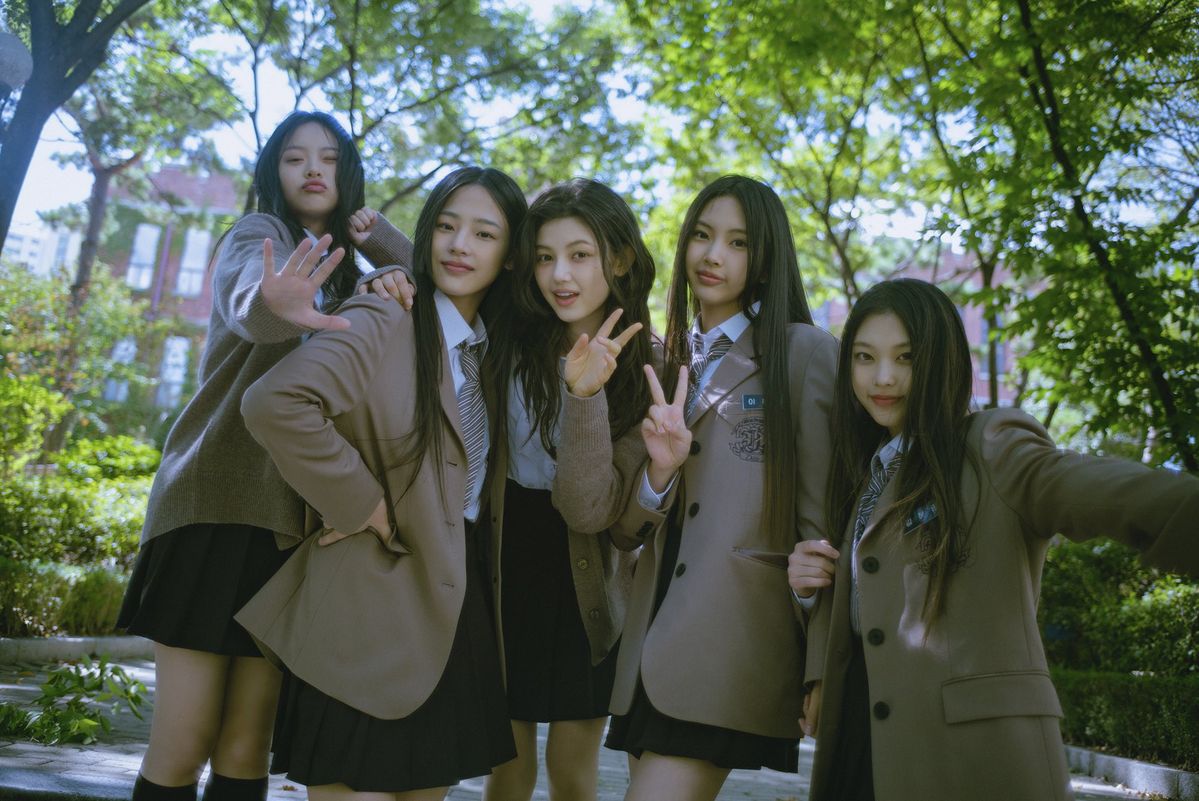 Still from "Ditto" MV, dir. Shin Woo-seok
The music video for "Ditto" opens not with the group but with an empty school hallway — fluorescent lights, winter uniforms, the particular loneliness of institutional spaces after hours. Director Shin Woo-seok of Dolphiners Films constructs a narrative that splits across two timelines, blurring the boundary between memory and the present. The cinematography employs a desaturated palette — muted blues, institutional greens, the pale grey of a Korean winter sky — that positions the video in the tradition of East Asian art cinema rather than K-pop's usual high-saturation spectacle. A sixth figure haunts the frame: a deer, a girl who may or may not exist, the camera itself as an unreliable narrator. The visual language borrows equally from Hirokazu Kore-eda's domestic naturalism and the nostalgic texture of first-generation camcorder footage, creating something that feels less like a music video and more like a memory you're not entirely sure belongs to you.
Producer 250 constructs the track's sonic architecture almost entirely from negative space. The garage-house beat — shuffling hi-hats, muted kicks, a bassline that suggests rather than states — operates at a restrained 134 BPM, slow for a dance track, but the swing in the percussion creates an illusion of forward motion that never quite resolves. Park Jin-su's arrangement is an exercise in subtraction: piano stabs enter and exit without warning, synth pads evaporate just as they register, and the bridge strips away everything but a single sustained chord and the sound of breath. The vocal performances — multi-tracked into a choir of themselves during the chorus, hushed and conversational in the verses — carry an understated melancholy that belies the performers' youth. There is a deliberate flatness to the delivery, a rejection of the melismatic excess that defines so much of contemporary pop vocal production, that places "Ditto" closer to the conversational intimacy of UK underground dance music than to K-pop's theatrical traditions.
“A track that doesn't propel forward so much as pull gently backward — into the fog of a half-remembered winter.”ToneSpoon Editorial
What elevates the track beyond its impeccable production is its emotional architecture. "Ditto" weaponizes Y2K nostalgia — grainy synth pads, trip-hop-adjacent drum programming, the ghost of late-nineties R&B — but filters everything through a contemporary lens sharp enough to cut. The lyrics, co-written by Ylva Dimberg and Minji, capture a particular kind of longing: not the grand, declarative yearning of a power ballad but the quiet, almost embarrassed hope of wanting someone to feel the same way you do. It is a song about looking, and being looked at, and the terrifying possibility that both gazes might be one-sided. The Korean title is a transliteration of the English word, but its resonance in the song is distinctly untranslatable — a borrowed word made intimate through repetition, like a secret shared between friends.
"Ditto" arrived in December 2022 and immediately recalibrated industry assumptions about what a K-pop single could sound like — and sell. It spent fifteen weeks atop South Korean charts, became the longest-running Perfect All-Kill in Melon history, and earned NewJeans their first entry on the Billboard Hot 100. But the commercial benchmarks undersell the cultural impact. In a landscape saturated with key changes, beat drops, and genre switch-ups crammed into three-minute runtimes, here was a track that proved restraint was not merely an aesthetic choice but a commercially viable — perhaps commercially superior — one.
More than three years after its release, "Ditto" has not aged so much as settled — into playlists, into the collective understanding of what NewJeans represents, into the canon of K-pop singles that changed the direction of the genre. It remains the group's defining statement not because it is their biggest or brashest song but because it is the one that could only be theirs: a winter memory that refuses to fade, a question that still hangs in the air, waiting for an answer.